
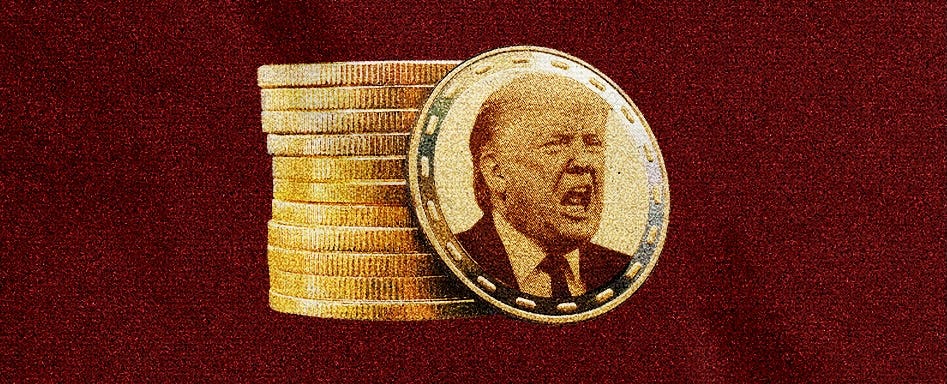
As the economy sputters and costs soar, the rich are getting richer and the world has its first trillionaire.
The president of the United States is making billions off crypto, building a gold-plated ballroom, giving millions to his friends for botched monument renovations, and saying things like “I don’t think about Americans’ financial situation, I don’t think about anybody.”
Republicans in Congress have spent the past two years ripping healthcare away from Americans, and cutting taxes for the ultra-wealthy while doing nothing to rein in the corruption of the regime or its price-gouging corporate enablers and benefactors.
It’s a masterclass in bad politics. And if you’re asking – as many of us who’ve grown a guarded, hard-shelled skepticism after the past ten years of US politics are wont to do – “is any of this breaking through?” The answer is YES.
New polling by Indivisible, conducted with Lake Research Partners, found that voters in 2026 battleground states* strongly connect the affordability crisis to corporate greed and political corruption – with the Trump regime taking the most blame.
Neither party is popular with battleground voters – Republicans are less popular – but politicians who are seen as fighters taking on powerful interests and corruption fared far better than party leaders.
The polling points to a clear messaging opportunity for Democrats this cycle: Voters want lowering costs to be the tangible promise, and see accountability and anti-corruption reforms as the mechanism for delivering it. People believe the system is rigged to benefit politicians, powerful interests, and corporations at the expense of ordinary people, and battleground voters want elected leaders to do more than just talk about the economy. They want elected leaders to put forward a concrete plan to lower costs by tackling the corruption and special interests they believe drive economic unfairness.
Here are our top findings:
1. 2026 battleground voters see a rigged system and want their elected leaders to fix it.
Battleground voters believe the economy is rigged to benefit powerful interests at the expense of ordinary people. 71% of voters are extremely concerned about politicians rigging the system, while a majority of 2026 battleground voters say rising costs are primarily caused by greedy corporations, corrupt CEOs, and price gouging, compared with a smaller share who attribute rising costs primarily to government spending and waste.
2. 2026 battleground voters see the Trump regime as the biggest center of corruption.
Asked where corruption is a very serious problem, more voters named Trump and his administration than any other answer – options which included other politicians, big pharma, corporations, and corporate billionaires. 71% of 2026 battleground voters said corruption by Trump and his administration is a somewhat or very serious problem.
Asked who has benefited the most financially from Trump’s second presidency, only 18% of battleground voters (and just 30% of self-identified Republican voters) said people like themselves. The top answers: Trump and his family.
At the same time, when asked about who is to blame for corruption existing in the political system, voters took a more structural view, putting corrupt politicians, super PACs and megadonors, lobby groups, and corporations high on the list.
Vitally for candidates, messaging on affordability and accountability that centers Trump tends to resonate less with voters than more comprehensive formulations against corrupt politicians and corporations driving up costs. Voters see Trump as part of a corrupt system, but want that system itself confronted.
3. Voters respond to messages about affordability and accountability more than either message by itself.
Battleground voters overwhelmingly agree that politicians need a concrete plan to make life more affordable (90%) and must focus on both lowering costs and addressing corruption (88%). 73% of voters are more likely to support a candidate who fights for both lower costs and accountability.
4. Anti-establishment politicians who take on corruption are viewed more favorably than either party because they have that credibility.
In 2026 battleground states, Bernie Sanders, Alexandria Ocasio-Cortez, and Zohran Mamdani are viewed almost twice as favorably as Hakeem Jeffries and Chuck Schumer.
Congressional Democrats favorable/unfavorable: 45%/53%
Congressional Republicans favorable/unfavorable: 29%/53%
Chuck Schumer favorable/unfavorable: 28%/62%
Hakeem Jeffries favorable/unfavorable: 27%/46%
AOC favorable/unfavorable: 53%/40%
Bernie Sanders favorable/unfavorable: 58%/38%
Zohran Mamadani favorable/unfavorable: 52%/36%
5. Voters want concrete action against corruption and greed.
Voters overwhelmingly support specific reforms that connect accountability to their economic lives:
91% favor a ban on congressional stock trading,
85% favor protecting ratepayers from utility increases driven by data centers,
82% support limits on billionaire influence over elections, and
81% favor cracking down on corporate price gouging.
The lessons for Dems running in 2026 battlegrounds is clear: Voters are fed up with greed and corruption. They see corruption as inextricably linked to the affordability crisis, and they lean toward politicians who offer plans to address both.
Dems have a real opportunity to harness frustration with a rigged system in 2026 and 2028, especially as Trump is now seen as a central part of it. But they need to be seen as ready to take on the entire system, not just Trump – with concrete policies that address corporate greed and political corruption.
____
*2026 battleground states polled: AK, GA, IA, MI, MT, NE, OH, and TX. Polling was also conducted in 2028 battlegrounds, and with voters of color in Southern states with similar findings. Full poll memo here.
Interesting. On a related note I'm sure many voters are unhappy with the fact that candidates can lie with no consequences during their campaign. And I'm not talking about opinions. I'm talking about factual concepts verifiable with evidence that are allowed to go unchecked. This erodes confidence in elections which discourages citizen participation. I just finished Andrew Weissman's book, Liar's Kingdom, where he methodically sets the table and then provides a very well articulated, concrete way to deal with this, based on other countries' successes with the same issue. It’s short and on point. I recommend it.
I live in Pennsylvania, for 3.7 years. Previously, I lived on Long Island, NY for 58 years and upstate NY for 2.6 years. I'm a registered Democrat for 46 years. I'm retired and have never owned a home. I have never been more disillusioned with the Democratic Party as I currently am. At this point, I would actually put myself in the Democratic Socialists of America category. I feel that 10-15% of congressional democrats are wholeheartedly working for the people. I recently attended the March On Washington and listened to the many speakers, including Indivisible (✊️). I agreed with nearly all that was said, even by Hakeem Jeffries, although he no longer speaks for me, generally.
Just saying...